Lithium-ion batteries have been widely used in portable electronic devices, electric vehicles, and other fields. However, the development of conventional inorganic cathode materials is increasingly constrained by the limited and unevenly distributed supply of critical mineral resources. Organic electrode materials, with advantages such as structural designability, environmental friendliness, and resource sustainability, offer new options for developing green energy-storage technologies. Nevertheless, small-molecule organic cathodes readily dissolve in electrolytes during charge and discharge, leading to the loss of active materials and degradation of cycling performance. How to reconcile high redox activity with structural stability remains a key issue in this field. Although π–d conjugated metal–organic coordination polymers can enhance structural stability and suppress the dissolution of active materials through coordination interactions, they still face challenges such as insufficient utilization of active sites caused by polymer-chain entanglement, as well as limited operating voltage and energy density due to low-potential n-type ligands.
Recently, the research group of Associate Professor Chenlong Dong, Associate Professor Zhiqiang Luo, and Professor Zhiyong Mao at Tianjin University of Technology published a Viewpoint article entitled “Insoluble π–d-Conjugated Small Molecules Featuring p-Type Ligands Enable All-Organic Dual-Ion Batteries” in the internationally renowned academic journal ACS Energy Letters.
This study successfully constructed π–d conjugated small molecules BTD-M that combine intrinsic insolubility and fully exposed active sites through the synergistic coordination of high-voltage p-type ligands with metal nodes. Among them, BTD-Cu exhibits excellent electrochemical performance owing to its ultra-narrow bandgap and the synergistic redox characteristics of the ligand and metal center. The symmetric all-organic dual-ion battery assembled based on BTD-Cu achieves an average operating voltage of 2.4 V and maintains 80% of its initial capacity after 1000 cycles. This study provides a new design strategy for organic electrode materials and all-organic energy-storage systems with high voltage, long cycle life, and high stability.
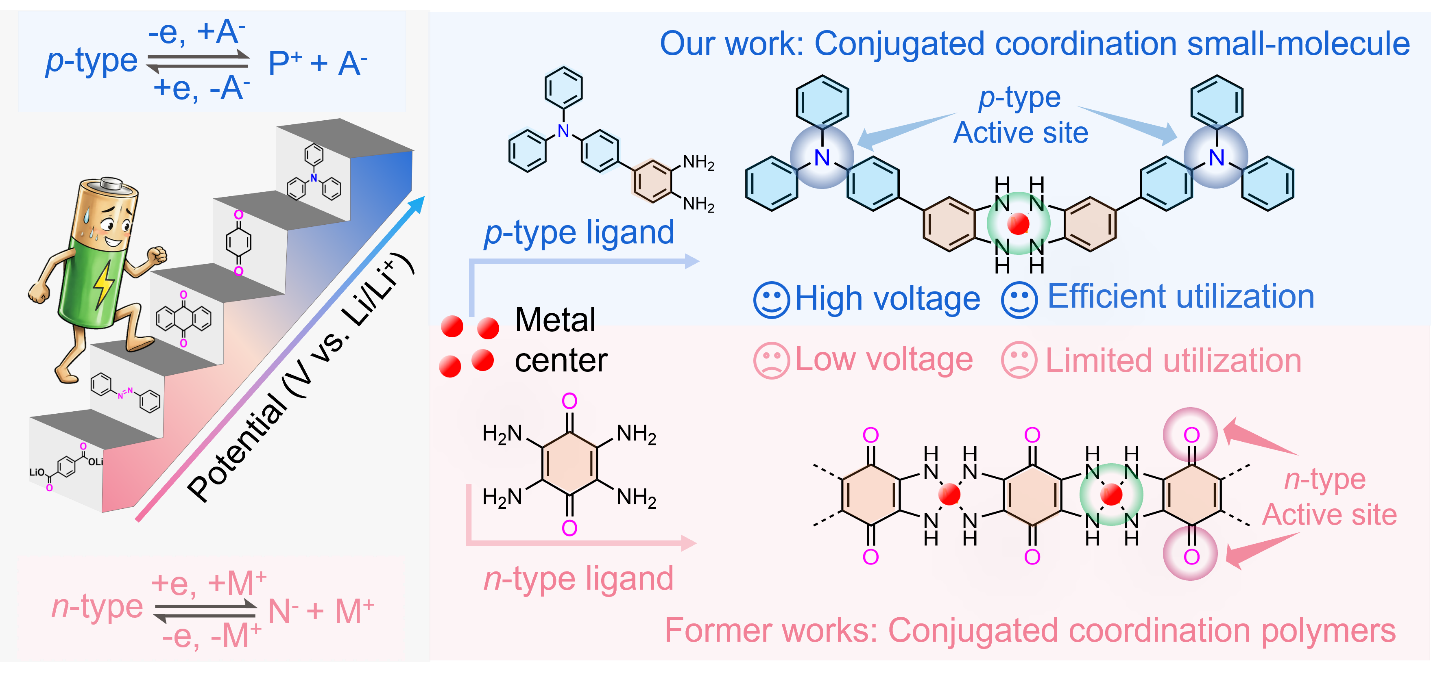
Figure 1. Schematic illustration of the design concept and advantages of the triphenylamine-based π-d conjugated small molecule metal-organic coordination compared to traditional π-d conjugated CCPs.
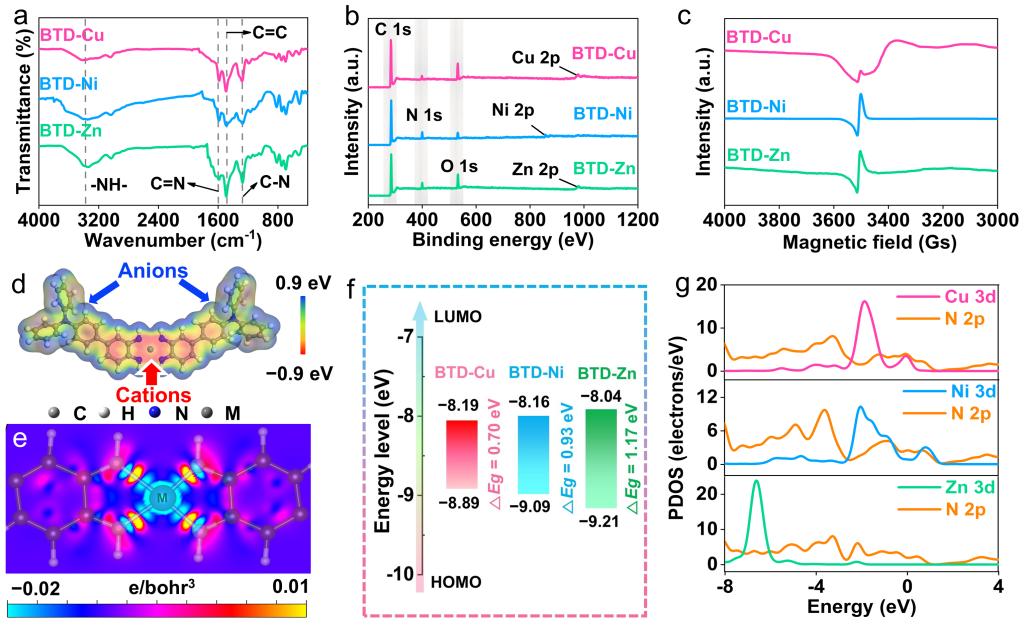
Figure 2. Structural characterization of the BTD-M. (a) FTIR spectrum, (b) XPS survey spectra and (c) EPR spectra of the BTD-Cu, BTD-Ni, and BTD-Zn. (d) MESP image and (e) differential charge density analysis of BTD-M. (f) The properties of frontier molecular orbitals and (g) PDOS of BTD-Cu, BTD-Ni, and BTD-Zn.
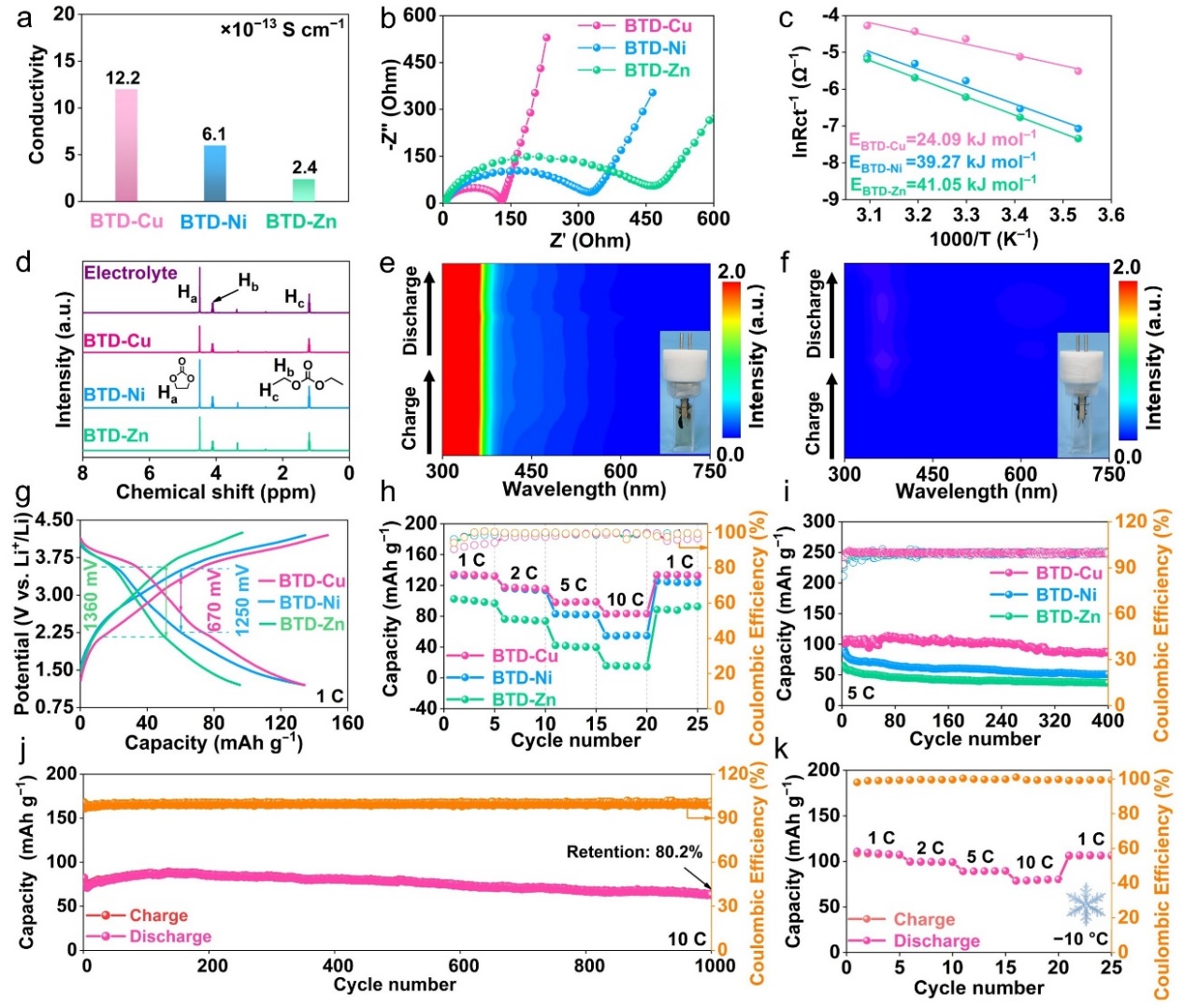
Figure 3. Electrochemical performances of the BTD-M.(a) Electrical conductivity, (b) Nyquist plots and (c) Arrhenius plots for the BTD-Cu, BTD-Ni and BTD-Zn. (d) 1H NMR spectra of the collected electrolytes after removing the soaked electrodes. The corresponding in situ UV-vis spectra of electrolyte for (e) BTD and (f) BTD-Cu electrode during the charging-discharging process. (g) GCD curves, (h) rate capacities and (i) cyclic performance of the BTD-Cu, BTD-Ni and BTD-Zn. (j) Long-term cycling performance of BTD-Cu at 10C over 1000 cycles. (K) Rate performance of BTD-Cu at −10 °C.
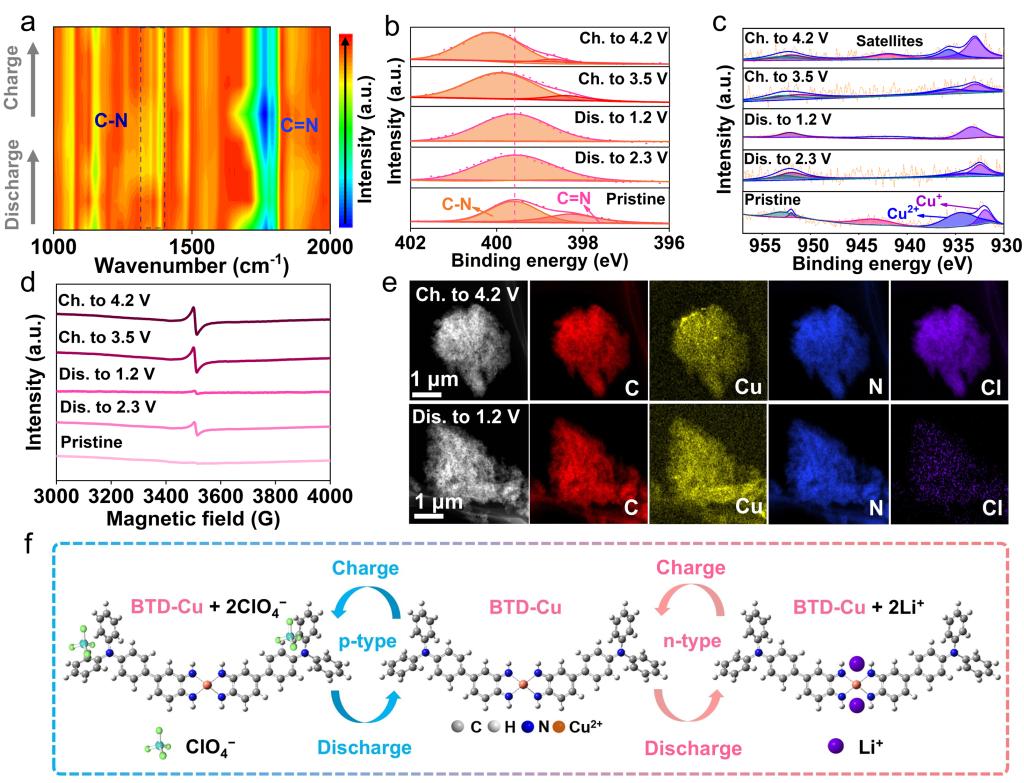
Figure 4. Charge storage mechanism of BTD-Cu. (a) in situ FT-IR spectra. (b) N 1s XPS, (c) Cu 2p XPS and (d) EPR spectra collected at different electrochemical states. (e) HAADF-STEM images and corresponding elemental mappings at different electrochemical states. (f) The charge storage mechanism of BTD-Cu.
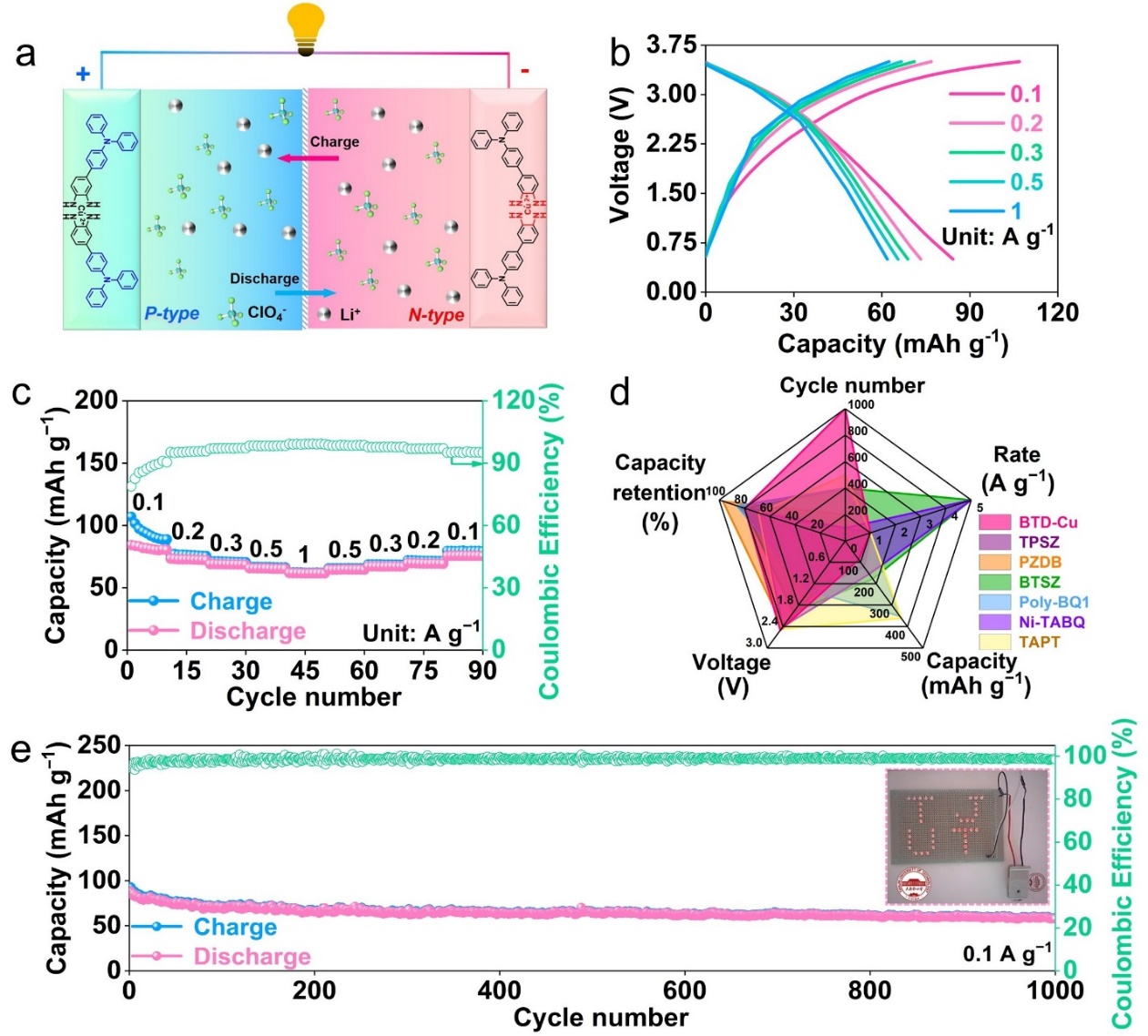
Figure 5. Performance of symmetric all-organic dual-ion batteries. (a) Schematic diagram of the BTD-Cu//BTD-Cu full battery. (b) GCD curves at different current densities. (c) Rate performance. (d) Electrochemical performance comparison radar chart for reported symmetric all-organic batteries. (e) cycling performance at 0.1 A g−1 (the inset shows the optical photograph of the SAOB powering an LED).
Their study was published in ACS Energy Letters on October 22th, 2026 (DOI: 10.1021/acsenergylett.6c02410).
