In-situ Oxysulfide Matrix Enables Ultrastable Germanium Anodes: New Work from Mao and Dong’s Team Published in Angewandte Chemie
Driven by the rapid advancement of electric vehicles and large-scale energy storage systems, there is a growing demand for lithium-ion batteries with high energy density and long cycle life. While cathode materials set the theoretical ceiling for energy density, realizing this potential hinges on the development of next-generation anode materials that combine high capacity and low operating voltage. Commercial graphite anodes are limited by a moderate specific capacity of approximately 360 mAh g-1, which restricts the driving range of batteries. Although silicon-based anodes feature ultrahigh theoretical capacity and have entered industrial deployment, they still suffer from complicated manufacturing routes for silicon-carbon composites, safety risks, and drastic volume expansion exceeding 300% during cycling. Such expansion triggers structural pulverization and rapid capacity decay. Even blending silicon-carbon composites into graphite, typically at a fraction below 20% in commercial products, fails to fully resolve these drawbacks.
Among high-capacity candidate materials, alloy-type metallic anodes including Ge, Sn and In have attracted widespread attention owing to their large theoretical capacities and low voltage plateaus. Germanium delivers a high theoretical capacity of 1623 mAh g-1 and favorable electrical conductivity. Nevertheless, germanium undergoes severe volume variation of around 250% upon lithiation and delithiation. This leads to structural collapse, particle pulverization and agglomeration, reduced active sites, and repeated fracture and reconstruction of the solid electrolyte interphase (SEI). The resultant fast capacity fading severely impedes practical implementation. Conventional modification strategies such as Ge-M alloying and nanocrystallization with carbon coating can partially mitigate volume expansion, yet severe agglomeration of Ge nanoparticles persists during cycling and remains unsolved. It is therefore critical and urgent to tailor the chemical environment surrounding Ge nanoparticles, regulate their microstructural evolution, and design functional matrices that robustly confine volume expansion and suppress agglomeration for viable high-capacity germanium anodes.
Researchers led by Chenlong Dong and Zhiyong Mao from Tianjin University of Technology, in collaboration with colleagues from the University of Chinese Academy of Sciences and Shanghai Jiao Tong University, have developed a novel germanium-based anode material SrGe2O4S to tackle the long-standing challenges of volume expansion and particle agglomeration that plague alloy-type anodes. During the initial charge–discharge process, this material in situ generates a unique inert Li2O/SrS matrix that tightly encapsulates and stabilizes nanoscale Ge particles. The matrix delivers multiple structural merits. Large, slowly migrating Sr2+ cations exert a prominent pinning effect to restrict Ge migration. Soft S2- anions exhibit strong affinity toward Ge to suppress agglomeration. Meanwhile, the high polarizability of S2- substantially lowers the Li+ diffusion barrier and enables fast reaction kinetics. The anode achieves outstanding electrochemical performance. It maintains a high reversible capacity of 587.5 mAh g-1 with a capacity retention of 93.2% after 800 cycles at 0.1 A g-1 over an extended testing period of 8300 hours (roughly 346 days). The paired LiCoO2||SrGe2O4S full cell delivers a capacity of 142.3 mAh g-1 based on the total mass of cathode and anode at 0.2 C, alongside an exceptional energy density of 482 Wh kg-1. Combined in situ and ex situ characterizations, theoretical calculations and finite element simulations elucidate the stabilization and stress-buffering mechanisms of the in situ formed inert matrix for Ge nanoparticles. This work offers an innovative strategy for designing alloy-type lithium anodes with high capacity and ultra-long cycle lifespan.
The related paper, entitled by Ultralong-cycling Lithium Storage of SrGe2O4S Anode Enabled by in situ Formed Oxysulfide Matrix, has been published in Angewandte Chemie International Edition. Associate Professor Chenlong Dong from the School of Materials Science and Engineering of Tianjin University of Technology and Associate Professor Ruiqi Wang from the University of Chinese Academy of Sciences serve as co-first authors. Associate Professor Ruiqi Wang, Professor Zhiyong Mao of Tianjin University of Technology and Professor Fuqiang Huang of Shanghai Jiao Tong University are the corresponding authors. DOI:https://doi.org/10.1002/anie.202508673.
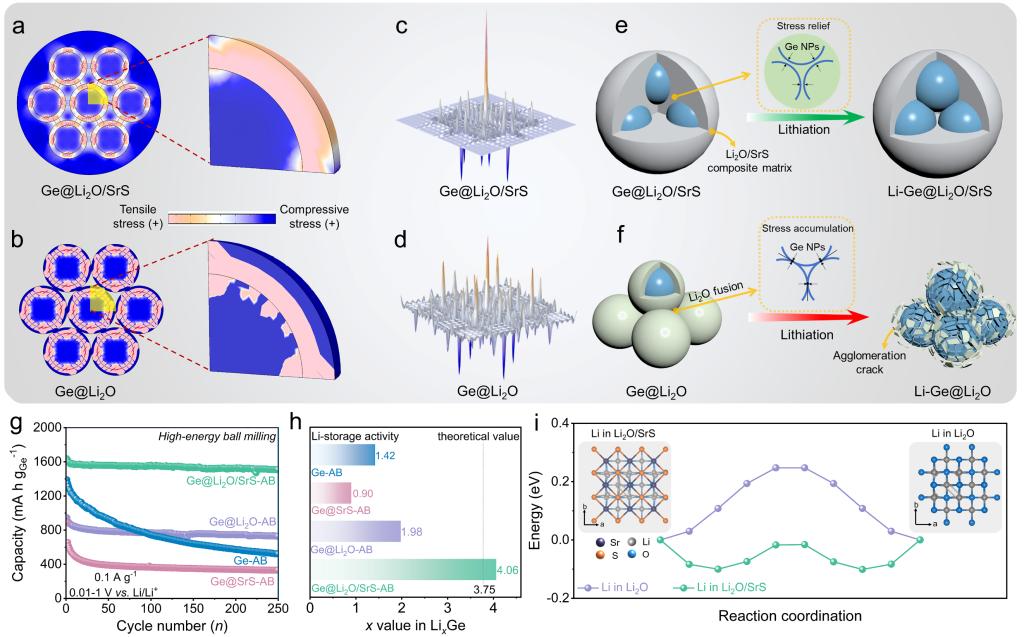
Figure. Schematic illustration of the mechanism for enhanced cycling stability of Ge-based anodes enabled by the Li2O/SrS matrix.
