Efficient conversion of solar energy into chemical energy represents a highly promising technical route to alleviate the global energy crisis and build a clean, low‑carbon and sustainable energy system. Metal‑Organic Frameworks (MOFs), featuring customizable structures, large specific surface areas, precisely tunable active sites and designable pore‑channel microenvironments, have emerged as crystalline porous catalytic materials that attract tremendous attention in the field of photocatalysis. Nevertheless, conventional MOF photocatalysts still suffer from critical bottlenecks including narrow light‑absorption range, rapid recombination of photogenerated carriers, insufficient active sites and poor structural stability under catalytic conditions, which severely limit their practical catalytic performance. Synergistic catalysis engineering is regarded as a core strategy to overcome the above limitations and improve the comprehensive performance of MOF‑based photocatalytic systems. Although numerous review articles concerning MOF photocatalysis have been reported, few reviews have systematically sorted out diverse intrinsic synergistic catalytic mechanisms within MOF materials, nor summarized the correlation between synergistic effects and various reaction scenarios for solar‑to‑chemical energy conversion.
Professors Mei Wang and Tong-Bu Lu at Tianjin University of Technology have systematically summarized the latest research advances in synergistic catalytic effects of MOF‑based photocatalytic materials. The review classifies the synergistic effects in MOF systems into four core categories: metal‑ligand synergy, bimetallic‑site synergy, ligand‑ligand synergy, and MOF-based composite synergy. The intrinsic mechanisms behind various synergistic modes are systematically analyzed from four perspectives: light‑absorption regulation, separation and migration of photogenerated charges, band‑gap engineering, and active‑site modulation. Meanwhile, it reviews the applications of such synergistic catalytic systems in photocatalytic water splitting, selective CO2 reduction to produce C1 and C2+ products, and organic transformation reactions, with emphasis on dissecting the structure‑activity relationship between synergistic configurations and photocatalytic performance. This paper also summarizes commonly‑used experimental characterization techniques and theoretical calculation methods for investigating photocatalytic mechanisms, outlines key challenges existing in this field, and provides prospects for the rational design of future MOF‑based photocatalysts. It offers theoretical guidance for developing high‑efficiency MOF photocatalysts toward solar‑to‑chemical energy conversion. This review, entitled Unraveling the Synergistic Catalysis Effect in MOF‑Based Photocatalysts, has been published in the internationally renowned journal Advanced Materials.
Full‑text link: https://doi.org/10.1002/adma.74863
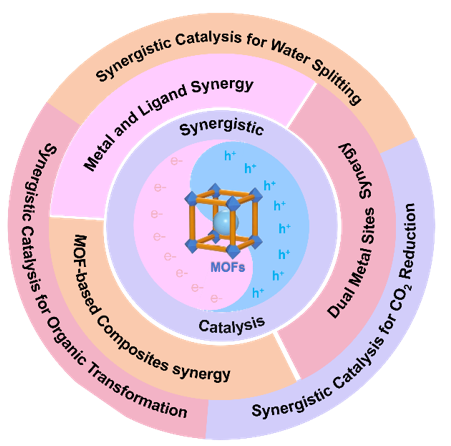
本文TOC示意图
